The short answer
A septic drain field, also called a leach field or soil absorption field, is a shallow, covered excavation in unsaturated soil where effluent from the septic tank is released and treated by the soil, as the U.S. EPA describes it. A drain field fails when a clogging layer called the biomat grows faster than the soil can absorb water, sending sewage to the surface or back into the house. HomeAdvisor warns that a failed leach field can cost up to $20,000 to fix.
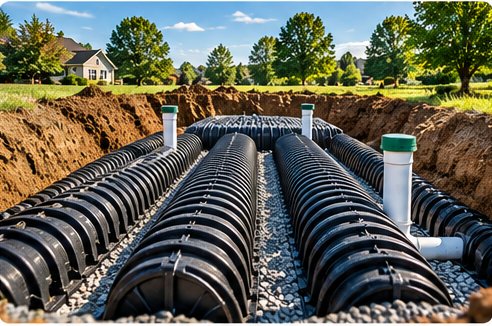
A septic drain field, also called a leach field or soil absorption field, is the part of a septic system where liquid from the tank is released into the soil and treated. The U.S. Environmental Protection Agency (EPA) describes the drain field as a shallow, covered excavation in unsaturated soil, where perforated pipes, chambers or similar units release effluent slowly so the soil can filter it, treat it and disperse it. Routine septic maintenance, from pumping to water conservation, is largely about protecting the drain field.
What is a septic drain field?
A septic drain field is the soil treatment stage of a conventional septic system. The EPA explains that wastewater first settles in the septic tank, where solids sink and grease floats, and the liquid effluent then flows to the drain field. The National Small Flows Clearinghouse at West Virginia University (WVU) notes that the soil provides “both wastewater treatment and ultimate dispersal.” That means the drain field is not just a disposal area; the soil under it does much of the actual treatment.
How does a septic drain field work?
A septic drain field works by spreading effluent over a large area of soil so bacteria and soil particles can remove contaminants before the water reaches groundwater. University of Georgia (UGA) Cooperative Extension describes three treatment processes in the soil: filtration, decomposition of organic material, and retention of pathogens.
The biomat
The biomat is a clogging layer that forms where effluent meets the soil, and it is central to how a drain field treats and why it eventually fails. UGA Extension says the biomat filters out most pathogens and parasites. WVU explains that it forms as soil bacteria consume contaminants and multiply; spreading effluent over a wide area limits its growth, and a stable balance between growth and die-off is called the long-term acceptance rate. If biomat growth goes unchecked, the field fails when water ponds to the surface.
How well soil treats septic effluent
Soil removes most solids and pathogens but much less nitrogen. UGA Extension reports these removal rates in 3 to 5 feet of soil:
| Constituent | Removal in soil (3-5 ft) |
|---|---|
| Total suspended solids | Over 90% |
| Total nitrogen | 10-20% |
| Total phosphorus | 0-100% |
| Fecal coliforms | Over 99.99% |
| Viruses | Over 99.99% |
Types of drain field designs
Septic drain fields come in several designs, chosen based on the soil and site. WVU describes:
- Conventional trenches. Typically 1 to 5 feet wide and up to 100 feet long, with one pipe each, usually 2 to 2½ feet deep. Narrow trenches are preferred.
- Beds. The whole area is excavated with several pipes; WVU notes some states no longer permit them.
- Pressure and low pressure pipe (LPP). Effluent is pumped through small-diameter pipe; LPP trenches can be as shallow as 1 foot.
- Serial and contour trenches. Trenches arranged in sequence or along the slope.
The EPA notes that conventional systems may use perforated pipe with gravel or chambers instead; see chamber septic systems. For the full system picture, see how septic systems work.
How long does a septic drain field last?
A septic drain field’s life depends on soil, design, installation and maintenance. Cornell Cooperative Extension puts the design life of a septic system at 20 to 30 years under the best conditions, and says the most common reasons for early failure are misuse and inadequate maintenance. WVU notes that installing two drain fields and alternating between them can prolong the system’s life.
What are the signs of drain field failure?
The signs of drain field failure show up both inside the house and in the yard. Cornell Cooperative Extension lists:
- Slowly draining sinks, bathtubs and toilets
- Dark, foul-smelling sewage backing up into drains or toilets
- Spongy or soggy ground, or standing water, above or near the drain field
- Lush green grass over the drain field, even during dry weather
- Nitrate, nitrite or coliform bacteria in well water
UGA Extension adds that untreated wastewater may surface, causing odors and health hazards, and the EPA says an overloaded drain field can flood and push sewage to the surface or back into toilets and sinks. UGA cites an estimate that 10 to 20% of U.S. onsite systems are not functioning properly. More warning signs are covered in signs of septic system failure.
What causes a septic drain field to fail?
A septic drain field usually fails because solids, water or physical damage overwhelm the soil. The causes named by WVU and Cornell include:
- Solids from an unpumped tank. Solids washing out of the tank clog the soil; see septic tank pumping.
- Too much water. Excess household water use, roof drains and high water tables saturate the soil.
- Uneven distribution. In gravity systems, effluent often exits the nearest holes and overloads the front of the field.
- Roots, vehicles and heavy equipment. Roots block pipes; traffic crushes pipes and compacts soil.
- Poor siting, design or installation. Cornell names improper location, poor design and poor installation.
Can a failed drain field be repaired?
A failed septic drain field can sometimes be repaired or renovated, but many require replacement. UGA Extension lists three options: full replacement, adding an extra drainfield, or renovating the existing one. Cornell Cooperative Extension adds:
- Enlarge the drainfield if it is too small for the household or the soil drains poorly, provided the tank is adequately sized.
- Install perimeter drains to lower soil water levels where saturated soil is the problem; Cornell says this works only in some cases.
- Use advanced treatment on small lots, near shorelines, or where soil is unsuitable. The EPA notes that aerobic pretreatment may extend drain field life and allow a smaller field; see aerobic septic systems.
- Join a cluster system or connect to sewer where available.
Some counties treat in-place renovation methods differently from replacement. The Florida Department of Health in Charlotte County requires extra documentation when a contractor repairs a system “through any method other than drainfield addition or replacement,” naming hydrogen peroxide treatment and high-pressure air injection as examples.
Pumping the septic tank gives temporary relief, especially with strict water conservation, according to Cornell, but it does not fix a failed field.
Drain field repair vs. replacement cost
Drain field work is among the most expensive septic repairs. HomeAdvisor warns that a failed leach field can cost up to $20,000 to fix, and puts repair of a single cracked or broken lateral line at $1,500 to $5,000. Current prices and what drives them are in drain field replacement cost.
Do you need a permit for drain field repair?
Drain field repair or replacement usually requires a permit from the local health department. Cornell Cooperative Extension advises using a qualified professional and local permits for drainfield or full-system replacement. In Charlotte County, Florida, a permit is required to repair or replace a system, and engineer-sealed plans are required when the drainfield exceeds 1,500 square feet. Rules elsewhere vary; see septic licensing by state.
How do you take care of a septic drain field?
Septic drain field care comes down to keeping solids, extra water and weight off it. The EPA recommends:
- Don’t park or drive on the drain field.
- Plant trees at the distance a septic professional recommends so roots stay out of the system.
- Keep roof drains, sump pumps and other rainwater systems away from the drain field.
- Don’t pave or build over it without checking with a local designer or permitting authority.
- Plant grass, not gardens. Avoid trees, shrubs and vegetable gardens; native grasses and ground covers are the best choice.
- Spread out laundry so the field isn’t flooded in one day.
Find a licensed drain field contractor
The Septic Guide lists 28,546 septic companies and licensed septic professionals in 45 states. Search septic companies near you for installers who handle drain field repair and replacement, and confirm the contractor’s license with how to check a septic contractor license before any digging starts.
Common questions
What is a septic drain field?
A septic drain field is the part of a septic system that releases liquid effluent from the tank into the soil for final treatment. The U.S. EPA describes a drain field as a shallow, covered excavation in unsaturated soil, where perforated pipes, chambers or similar units release effluent slowly so the soil can filter it.
What are the signs of a failing drain field?
The signs of a failing drain field include slow drains, sewage backing up into the house, soggy ground or standing water over the field, and grass over the field that stays lush and green in dry weather. Cornell Cooperative Extension also lists odors and nitrate or coliform bacteria in well water as warning signs.
Can a septic drain field be repaired instead of replaced?
A septic drain field can sometimes be repaired or renovated instead of replaced. University of Georgia Cooperative Extension lists full replacement, adding an extra drainfield, and renovating the existing one as options, and Cornell Cooperative Extension adds enlarging an undersized field or installing perimeter drains where saturated soil is the problem.
What is a leach field?
A leach field is another name for a septic drain field. The terms leach field, drain field, drainfield, soil absorption field and soil treatment area all describe the trenches or beds where septic tank effluent is released into the soil for treatment.
Sources
- How Septic Systems Work, U.S. Environmental Protection Agency. Accessed October 20, 2026. Drainfield is a shallow, covered excavation in unsaturated soil; overloaded drainfield can flood
- Technical Overview: Soil Absorption Systems, National Small Flows Clearinghouse, West Virginia University. Accessed October 20, 2026. Biomat and long-term acceptance rate; trench dimensions; bed, pressure, LPP, serial and contour designs; failure causes; alternating fields
- The Drainfield and the Soil (Bulletin 1242-4), University of Georgia Cooperative Extension. Accessed October 20, 2026. Soil treatment and removal rates; biomat; repair options; 10-20% of U.S. onsite systems estimated not functioning properly
- Your Septic System: Septic System Failure, Cornell Cooperative Extension. Accessed October 20, 2026. Failure signs and causes; long-term options; design life 20 to 30 years
- How to Care for Your Septic System, U.S. Environmental Protection Agency. Accessed October 20, 2026. Drainfield care: no parking, trees at recommended distance, divert roof and sump water, no pavement, grass cover
- How Much Does Septic Tank Repair Cost?, HomeAdvisor. Accessed October 20, 2026. Leach field failure can cost up to $20,000 to fix; lateral line $1,500-$5,000 (updated June 2026)
- Repair/Replacement Permit, Florida Department of Health in Charlotte County. Accessed October 20, 2026. Permit to repair or replace; extra documentation for non-drainfield methods; engineer-sealed plans above 1,500 sq ft drainfield
- Decentralized Systems Technology Fact Sheet: Aerobic Treatment (EPA 832-F-00-031), U.S. Environmental Protection Agency. Accessed October 20, 2026. Aerobic pretreatment may extend drainfield life and allow a smaller drainfield