The short answer
Septic system installation follows a fixed sequence: site evaluation, soil and percolation testing, system design, a permit from the local authority, excavation and installation by a licensed installer, and a final inspection before backfill. Premier Tech says permit decisions usually take a few days to a few weeks, and the Town of Pembroke, Massachusetts, tells homeowners to allow about three to four months for the whole process. Installer licensing is set by states and counties; Texas, for example, issues Installer I and Installer II licenses through the TCEQ.
Septic system installation is a permitted construction project that moves through a fixed sequence: site evaluation, soil and percolation testing, system design, a permit from the local authority, excavation and installation by a licensed installer, and a final inspection before the trenches are covered. Wastewater treatment manufacturer Premier Tech describes the same seven-step order, and the Town of Pembroke, Massachusetts, tells homeowners to allow about three to four months for the whole process. The digging itself is a small share of that time; testing, design and permitting take most of it.
What are the steps to install a septic system?
The steps to install a septic system are the same in most places, even though the specific rules and forms differ by state and county. This table summarizes the sequence described by Premier Tech:
| Step | Who does it | What happens |
|---|---|---|
| 1. Site evaluation | A site evaluation specialist | Assesses the land and measures distances to wells, water bodies and property lines |
| 2. Soil testing | A qualified specialist | Deep probe test and percolation (perc) test |
| 3. System design | A septic designer | Chooses the system type and size, lays out the dispersal area, prepares the permit design |
| 4. Installation permit | Local authority (application usually filed by the contractor, installer or engineer) | Reviews and approves the design |
| 5. Excavation and installation | A licensed installer | Prepares the site, digs, places and connects components |
| 6. Electrical connections (if needed) | A licensed electrician | Connects pumps, float switches or alarms before the system is covered |
| 7. Inspection and sign-off | Local authority | Checks the work against the approved design; the installer then backfills |
Step 1: Site evaluation
A septic site evaluation determines whether and where a system can go on the lot. The evaluator measures setbacks from wells, water bodies and property lines, per Premier Tech. In Texas, preconstruction site evaluations are done by holders of a TCEQ Site Evaluator license or a Texas Professional Engineer license.
Step 2: Soil testing and the perc test
Septic soil testing checks whether the ground can absorb and treat wastewater. The EPA’s fact sheet on aerobic treatment notes that conventional absorption beds generally require percolation faster than 60 minutes per inch, 2 to 4 feet of soil above the water table or bedrock, and level or gently sloping ground. The National Small Flows Clearinghouse at West Virginia University (WVU) adds that research suggests 24 inches of vertical soil is sufficient for treatment, though many states require 36 or 48 inches.
Step 3: System design
A septic system design matches the system type and size to the soil and the house. The designer picks the system, sizes the dispersal area, and produces the document the permit application relies on. When the soil is marginal, the design may call for an alternative system instead of a conventional one; see types of septic systems.
Step 4: The installation permit
A septic installation permit is issued by the local permitting authority after it reviews the design. Premier Tech says the application is usually submitted by licensed septic contractors, installers or engineers, and that a decision typically comes within a few days to a few weeks, longer for complex projects. Permit rules and fees are covered in septic permits.
Step 5: Excavation and tank placement
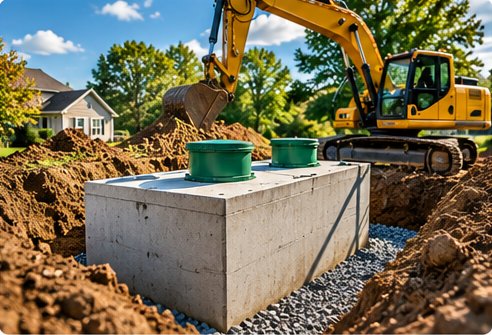
Septic tank installation means setting a buried, watertight container, usually concrete, fiberglass or polyethylene according to the EPA, and connecting it to the house so all household wastewater drains through one main pipe into the tank. The installer prepares the site, digs, places the tank, and connects the components.
Step 6: Building the drain field
A conventional septic drain field is a set of shallow trenches that release tank effluent into the soil. WVU’s National Small Flows Clearinghouse describes a typical conventional trench as about 6 inches of gravel, a 4-inch perforated PVC pipe with holes facing down, 2 more inches of gravel over the pipe, a geotextile or building-paper cover, and about a foot of backfilled soil. Conventional trenches are typically 2 to 2½ feet deep. More on how the field works is in septic drain fields.
Step 7: Electrical work, if required
Septic systems with pumps, float switches or alarms need a licensed electrician to make the connections before anything is covered, per Premier Tech. Gravity-only systems skip this step.
Step 8: Final inspection and backfill
A septic final inspection happens while the system is still exposed. Premier Tech says excavations stay open until the authority inspects the work against the approved design and issues written approval; only then does the installer backfill. In King County, Washington, Public Health describes a replacement process in which the designer inspects the installation first and Public Health inspects it after.
How long does septic system installation take?
Septic system installation typically takes about three to four months from first test to final approval, according to the Town of Pembroke, Massachusetts, which says finishing in under two months is the exception. Pembroke names three common causes of delay:
- Perc test scheduling. The test depends on when the health agent is available to witness it.
- Professional backlogs. Engineers and installers are often booked months in advance.
- Variances. If the design needs a local or state variance, public or variance hearings add time.
Premier Tech’s estimate of a few days to a few weeks for the permit decision is one piece of that total.
Who is allowed to install a septic system?
Septic system installers are licensed or certified by state or local agencies in much of the country; The Septic Guide matches contractors against license or certification lists published by 26 state agencies. The scope of a license can depend on the system type, and Texas is a clear example. The Texas Commission on Environmental Quality (TCEQ) issues:
- Installer I licenses for standard systems, including septic tanks, absorptive drainfields, leaching chambers, gravel-less pipe and pumped effluent drainfields.
- Installer II licenses for all types of on-site sewage systems.
- Apprentice registrations, which allow installation work only under the constant, direct supervision of a licensed installer.
In King County, Washington, repairs require a certified master installer, and replacements require a certified designer, master installer or qualified professional engineer depending on size. Requirements in other states differ; see septic licensing by state or the Texas septic licensing page.
What happens if the soil fails the perc test?
A failed perc test usually means the site needs an alternative septic system rather than a conventional one. The EPA explains that alternative systems use pumps or gravity to move effluent through sand, organic matter such as peat or sawdust, constructed wetlands or other media, and some evaporate or disinfect the wastewater before it reaches the soil. The EPA’s fact sheet on aerobic treatment says aerobic septic systems suit homes with inadequate land or soil, high water tables, wooded lots, or lots near water bodies.
New septic installation vs. replacement
A septic system replacement follows the same basic path as a new installation, with design, permit, installation and inspection, but starts with an existing system that has failed. King County’s replacement process, for example, begins with a design proposal from a designer, master installer or qualified engineer and ends with inspections by the designer and Public Health.
How much does septic system installation cost?
Septic system installation cost varies widely with system type, soil and region. Penn State Extension puts replacement or new installation at $10,000 to $60,000 or more in Pennsylvania. Publisher averages and price drivers are covered in septic system installation cost.
What should you do after a new septic system is installed?
A new septic system needs routine care from the first year. The EPA recommends having a typical system inspected at least every three years (once a year for systems with pumps, float switches or other mechanical parts), pumping the tank typically every three to five years, and keeping records of all work. The EPA also advises keeping vehicles off the drain field and keeping roof drains and sump pumps away from it. A full schedule is in septic system maintenance.
Find a licensed septic installer
The Septic Guide lists 28,546 septic companies and licensed septic professionals in 45 states, including installers. Search septic companies near you, and before signing a contract, confirm the installer’s license with the state or county that issued it using how to check a septic contractor license.
Common questions
How long does it take to install a septic system?
Septic system installation usually takes months from start to finish once testing, design and permitting are counted. The Town of Pembroke, Massachusetts, tells homeowners to allow approximately three to four months and says finishing in under two months is the exception, mainly because perc tests, engineers and installers must all be scheduled.
Do you need a permit to install a septic system?
A new septic system needs an installation permit from the local permitting authority before construction. Premier Tech notes that licensed septic contractors, installers or engineers usually submit the application and that a decision typically comes within a few days to a few weeks, longer for complex projects.
What is a perc test for a septic system?
A perc (percolation) test measures how fast water soaks into the soil where a septic drain field would go. The EPA's aerobic treatment fact sheet notes that conventional absorption beds generally require percolation faster than 60 minutes per inch, along with 2 to 4 feet of soil above the water table or bedrock.
Can a homeowner install their own septic system?
Whether a homeowner can install a septic system depends on state and local rules. In Texas, the TCEQ licenses installers, with Installer I covering standard systems, Installer II covering all system types, and apprentices working only under a licensed installer's direct supervision. Check your state on The Septic Guide's licensing pages.
Sources
- Overview of Steps to Install a Septic System, Premier Tech Aqua. Accessed October 20, 2026. Seven installation steps; permit decision in a few days to a few weeks
- How long does the process for installing / repairing a septic system take, from beginning to end?, Town of Pembroke, Massachusetts. Accessed October 20, 2026. Allow approximately three to four months; under two months is the exception
- How Septic Systems Work, U.S. Environmental Protection Agency. Accessed October 20, 2026. Tank and drainfield components; alternative systems
- Decentralized Systems Technology Fact Sheet: Aerobic Treatment (EPA 832-F-00-031), U.S. Environmental Protection Agency. Accessed October 20, 2026. Absorption beds generally need percolation faster than 60 minutes/inch and 2-4 feet to water table or bedrock
- Technical Overview: Soil Absorption Systems, National Small Flows Clearinghouse, West Virginia University. Accessed October 20, 2026. 24 inches of vertical soil sufficient per research, many states require 36 or 48; trench construction and depth
- Occupational Licenses: On-Site Sewage Facilities (Septic Systems), Texas Commission on Environmental Quality. Accessed October 20, 2026. Site Evaluator, Installer I, Installer II and Apprentice license types
- Septic System Repair and Replacement, Public Health - Seattle & King County. Accessed October 20, 2026. Replacement permit process: designer proposal, permit, installation by master installer, designer and Public Health inspection
- On-Lot Septic System Inspections During Real Estate Transactions, Penn State Extension. Accessed October 20, 2026. Replacement or new installation $10,000 to $60,000 or more
- How to Care for Your Septic System, U.S. Environmental Protection Agency. Accessed October 20, 2026. Inspection and pumping intervals; drainfield care