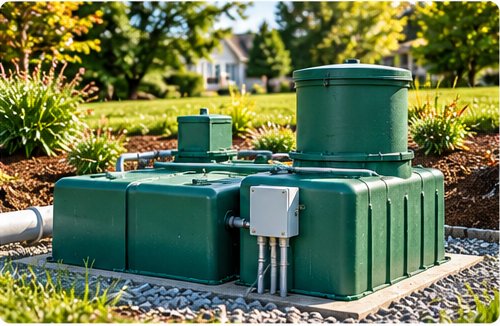
The short answer
An aerobic septic system, or aerobic treatment unit (ATU), injects air into the wastewater so oxygen-dependent microbes break it down, producing cleaner effluent than a conventional septic tank. The U.S. EPA says aerobic units suit lots with poor soil, high water tables or nearby water, but they need electricity and more frequent maintenance. In Texas, the TCEQ requires aerobic systems to be maintained under contract with a licensed maintenance provider who reports at least once every four months.
An aerobic septic system, also called an aerobic treatment unit (ATU), is an onsite wastewater system that injects air into the wastewater so oxygen-dependent microbes break it down. The U.S. Environmental Protection Agency (EPA) says aerobic units operate at a higher rate and produce better effluent than conventional septic tanks, which rely on settling and oxygen-free bacteria. The trade-off is that an aerobic septic system has moving parts, uses electricity, and needs regular professional maintenance.
What is an aerobic septic system?
An aerobic septic system is a pre-engineered treatment unit that adds oxygen to household wastewater. Oklahoma State University (OSU) Extension describes an ATU as “essentially a scaled-down version of a centralized activated sludge wastewater treatment plant.” Texas A&M AgriLife Extension notes that, beyond settling, an ATU breaks down dissolved solids and ammonia and reduces pathogens.
Residential units are certified to a national standard. The EPA’s fact sheet explains that NSF Standard 40 certifies units of up to 1,500 gallons per day, and that Class I certification requires meeting EPA secondary treatment guidelines for biochemical oxygen demand (BOD), suspended solids and pH, along with limits on noise, odor, oily films and foaming.
How does an aerobic treatment unit work?
An aerobic treatment unit works in stages, each in its own tank or chamber. This table combines the treatment train described by Texas A&M AgriLife Extension and OSU Extension:
| Stage | What happens |
|---|---|
| Trash tank (pretreatment) | Solids settle and grease floats, as in a septic tank |
| Aeration chamber | A compressor or aerator bubbles air through the wastewater so microbes digest the waste |
| Clarifier | Microbial cells and fine solids settle out; settled sludge returns for more treatment |
| Disinfection | Chlorine or UV light inactivates pathogens before surface discharge |
| Pump tank | Holds treated effluent for dosing |
| Dispersal | Spray heads on a lawn, subsurface drip lines, or a subsurface field |
Texas A&M AgriLife Extension notes that aerobic systems “must have a continuous supply of oxygen to keep the microbes healthy,” and that chlorination is the most common form of disinfection. OSU Extension says disinfection is required only for spray irrigation in Oklahoma and that UV is an option but seldom used.
How much water can an aerobic system treat?
An aerobic system is sized by gallons per day, and short bursts of heavy use can overwhelm it. Texas A&M AgriLife Extension says most residential aerobic systems can treat 500 gallons a day, or 60 gallons per hour, and that a clothes washer using 30 to 40 gallons per load can strain a system with that hourly capacity. The EPA notes that hydraulic surges can cause serious clarifier malfunctions.
How clean is aerobic effluent?
Aerobic effluent is cleaner than septic tank effluent. The EPA’s fact sheet reports that suspended growth units achieve 70 to 90 percent reductions in BOD and suspended solids, with effluent as low as 20 mg/L, and normally achieve nitrification. Phosphorus reduction is normally less than 25 percent.
Where are aerobic septic systems required?
Aerobic septic systems are typically used, and sometimes required, where the soil or lot cannot support a conventional drain field. The EPA lists homes with inadequate land or soil, high water tables, wooded lots, and lots near water bodies as good fits, and says a common use is replacing failing septic systems. The EPA also notes that aerobic pretreatment may extend the life of a drain field and allow a smaller one.
Whether an ATU is mandatory depends on state and local rules and on the site evaluation. When the soil fails the tests for a conventional system, the designer chooses among alternatives; see types of septic systems and aerobic vs. conventional septic.
Do aerobic septic systems need a maintenance contract?
Aerobic septic systems often must be covered by a maintenance contract, depending on the state. Texas has detailed rules. The Texas Commission on Environmental Quality (TCEQ) says:
- Licensed provider. The contract must be with a licensed maintenance provider, who must be an individual person; technicians working under that provider must be registered and directly supervised.
- Reporting. The provider must submit a report to the permitting authority and the owner at least once every four months, or once every six months if an electronic monitor alerts the provider to failures and tracks disinfection. Reports are due within 14 days of testing.
- Repairs. If a component is not working properly, the property owner must have it repaired.
- Contract terms. The contract must state the covered items, a response time for complaints, the name of the person doing the work, the frequency of maintenance, testing and reporting, and who maintains the disinfection unit.
- Homeowner maintenance. Two years after installation, homeowners may perform maintenance on these systems, unless the local permitting authority has stricter rules.
Texas A&M AgriLife Extension says an ATU is inspected usually once every four months, and that a basic monitoring contract meets the state’s minimum but leaves more of the upkeep to the homeowner. See Texas septic licensing for how maintenance providers are licensed; for other states, see septic licensing by state.
What the maintenance visit covers
An aerobic maintenance visit checks the mechanical, biological and disinfection parts of the system. OSU Extension’s inspection guidance lists the control panel, aerator and airflow, aeration chamber, pump tank floats (including the high-water alarm float), disinfectant level, and the sprinkler or drip dispersal. The EPA’s fact sheet adds that sludge must be removed periodically, typically every 8 to 12 months.
What should homeowners do to maintain an aerobic system?
Homeowners with an aerobic septic system handle daily care between service visits. OSU Extension recommends:
- Listen for the compressor and check chlorine levels often.
- Watch the spray heads, since faulty heads are a common ATU problem.
- Call the maintenance provider if an alarm sounds, don’t repair it yourself, and cut nonessential water use until it is fixed. See septic alarms.
- Stay within design capacity and stagger heavy water use when guests are staying.
- Keep grease, cooking oil, excess cleaners, unused antibiotics, pesticides, paint thinners and solvents out of drains.
- Ease back in after a trip. Reduce water use for at least two days after an absence so the microbes can recover.
Texas A&M AgriLife Extension adds that chlorine tablets should not be stored in the house, garage, or storage areas with metal tools.
What are the pros and cons of aerobic septic systems?
Aerobic septic systems treat wastewater better but cost more to run. The EPA’s fact sheet lists:
| Advantages | Disadvantages |
|---|---|
| Higher level of treatment than a septic tank | Higher operating costs than septic systems |
| Helps protect water where septic systems fail | Requires electricity |
| Alternative for sites unsuited to septic systems | Mechanical parts can fail |
| May extend drain field life and allow a smaller field | Needs more frequent routine maintenance |
| Reduces ammonia discharged to receiving waters | Vulnerable to upsets from sudden heavy loads or neglect |
| May release more nitrates to groundwater than septic systems |
The EPA puts electricity use at 2.5 to 10 kWh per day for suspended growth units and 1 to 4 kWh per day for fixed film units. OSU Extension notes that ATUs need consistent use to keep the microbes fed, which makes them a poor fit for seasonal or vacation homes.
How much does an aerobic septic system cost?
An aerobic septic system costs more to install and to operate than a conventional system, according to the EPA’s fact sheet. Current installation prices, maintenance contract prices and replacement part costs are covered in aerobic septic system cost.
Find a licensed aerobic system provider
The Septic Guide lists 28,546 septic companies and licensed septic professionals in 45 states, with 27,065 matched to license or certification lists published by 26 state agencies. Search septic companies near you for installers and maintenance providers, and verify the license with how to check a septic contractor license before signing a service contract.
Common questions
What is an aerobic septic system?
An aerobic septic system is an onsite wastewater system that pumps air into a treatment tank so oxygen-dependent microbes break down the waste. The U.S. EPA says aerobic treatment units achieve better effluent quality than septic tanks, and Oklahoma State University Extension describes them as a scaled-down version of a municipal activated sludge plant.
How often does an aerobic septic system need to be serviced?
An aerobic septic system is typically inspected every four months, according to Texas A&M AgriLife Extension, and Texas requires maintenance providers to report at least once every four months. The U.S. EPA's homeowner guidance says systems with pumps, float switches or other mechanical parts should generally be inspected at least once a year.
Do aerobic septic systems need electricity?
Aerobic septic systems need electricity to run the air compressor or aerator and the pumps. The U.S. EPA's aerobic treatment fact sheet lists electricity use of 2.5 to 10 kWh per day for suspended growth units and 1 to 4 kWh per day for fixed film units.
Can I maintain my own aerobic septic system in Texas?
In Texas, homeowners may perform maintenance on an aerobic treatment unit two years after its initial installation, according to the TCEQ. Some local permitting authorities have stricter rules, including required homeowner training or a ban on homeowner maintenance, so check with the local permitting authority first.
Sources
- Decentralized Systems Technology Fact Sheet: Aerobic Treatment (EPA 832-F-00-031), U.S. Environmental Protection Agency. Accessed October 20, 2026. How ATUs work; NSF Standard 40; applicability; 70-90% BOD and SS reduction; energy use; advantages and disadvantages (September 2000)
- Aerobic Treatment Unit Maintenance (B-6234), Texas A&M AgriLife Extension. Accessed October 20, 2026. Treatment stages; inspection usually every 4 months; 500 gallons/day or 60 gallons/hour; washer 30-40 gallons/load; chlorine safety
- OSSF Maintenance, Texas Commission on Environmental Quality. Accessed October 20, 2026. Licensed maintenance provider; reports every four months (six with electronic monitoring); homeowner maintenance after two years where allowed; contract contents
- Occupational Licenses: On-Site Sewage Facilities (Septic Systems), Texas Commission on Environmental Quality. Accessed October 20, 2026. Maintenance Provider license and Maintenance Technician registration
- Aerobic Treatment System (PSS-2275), Oklahoma Cooperative Extension Service, Oklahoma State University. Accessed October 20, 2026. Trash tank, aeration, clarifier, disinfection, pump tank; homeowner maintenance tips; reduce water use for two days after an absence
- Inspection of Septic Systems, Oklahoma State University Extension. Accessed October 20, 2026. Aerobic inspection checks: control panel, aerator, pump tank floats, disinfectant, dispersal
- How to Care for Your Septic System, U.S. Environmental Protection Agency. Accessed October 20, 2026. Systems with pumps, float switches or mechanical parts inspected generally once a year