The short answer
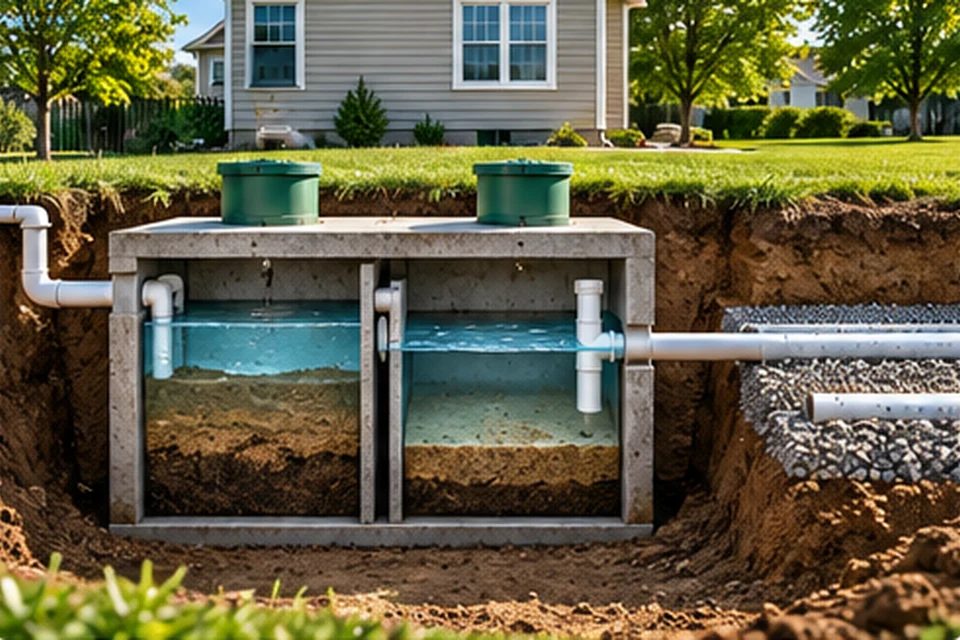
A septic system is an on-site wastewater system with two main parts: a buried, watertight septic tank and a drain field (soil absorption field), according to the U.S. EPA. In the tank, solids sink into a sludge layer and grease floats up as scum; the clarified liquid in the middle (effluent) flows out through a baffled outlet, usually to a distribution box, then into perforated pipes where the soil filters and treats it. Penn State Extension notes wastewater may spend at least 24 hours in the tank.
A septic system works by holding household wastewater in a buried, watertight tank long enough for solids to settle out, then sending the clarified liquid to a drain field where the soil filters and treats it. The U.S. EPA describes a typical septic system as two main parts, a septic tank and a drain field (also called a soil absorption field), and Penn State Extension adds a third component that sits between them on most conventional systems: the distribution box.
Every septic system does three jobs: separate solids from liquid, start breaking down the waste, and return treated water to the ground. The steps below follow the wastewater from the drain in your house to the groundwater.
What is a septic system?
A septic system is an on-site wastewater treatment system: it treats sewage on the property where it is produced instead of piping it to a municipal plant. Penn State Extension notes septic systems are also called on-lot or on-site sewage systems and are used in rural areas without centralized sewers. The EPA’s homebuyer guide calls them onsite wastewater systems and puts the average lifespan of a septic system at 15 to 40 years.
A septic system handles everything that goes down the drains, not only toilets. Bathroom, kitchen and laundry wastewater all flow through one main drainage pipe into the septic tank, according to the EPA.
What are the parts of a septic system?
A conventional septic system has five or six main parts. The New York State Department of Health lists the house sewer, septic tank, distribution box, trenches and laterals, absorption field and a plumbing vent.
| Component | What it is | What it does |
|---|---|---|
| House sewer (building drain) | Main pipe leaving the house | Carries all wastewater from fixtures to the tank (NYS DOH) |
| Septic tank | Buried, watertight container of concrete, fiberglass or polyethylene (EPA) | Settles solids into sludge, floats grease into scum, starts anaerobic digestion |
| Inlet baffle or tee | Pipe tee or wall baffle at the tank inlet | Directs incoming flow downward so settled solids are not stirred up (NJDEP) |
| Outlet baffle or tee | Pipe tee or wall baffle at the tank outlet | Holds back scum and solids so only effluent leaves (NJDEP, El Dorado County) |
| Effluent filter | Screen in the outlet baffle | Catches solids that could clog the drain field (Penn State Extension) |
| Distribution box (D-box) | Small watertight concrete or plastic box | Splits effluent evenly among drain field pipes (Penn State Extension) |
| Drain field (leach field, absorption area) | Perforated pipes in gravel, chambers or other media | Releases effluent into the soil for final treatment (EPA) |
| Soil | Unsaturated native soil below the drain field | Filters out particles, pathogens and nutrients (EPA, Penn State Extension) |
| Vent | Plumbing vent pipe | Releases gases from the plumbing (NYS DOH) |
How does a septic system work, step by step?
A septic system moves wastewater through four stages: collection, settling, distribution and soil treatment.
Step 1: Wastewater flows to the septic tank
Wastewater from every drain in the house runs through the house sewer into the septic tank. On a conventional system this happens by gravity, with no pump.
Step 2: The septic tank separates sludge, scum and effluent
The septic tank is a settling basin. The EPA explains that the tank holds wastewater long enough for solids to settle to the bottom, forming sludge, while oil and grease float to the top as scum. Penn State Extension notes that because there is no oxygen in the tank, anaerobic bacteria digest the solids; depending on tank size and household flow, wastewater may spend at least 24 hours in the tank. Purdue Extension likewise says wastewater needs about 24 hours in the tank to separate.
Bacterial digestion shrinks the sludge but never eliminates it. The New Jersey DEP primer says microbial action can reduce sludge by as much as 50%, and the rest accumulates until the tank is pumped.
The septic tank ends up with three layers:
- Scum (top): floating fats, oils, grease and light solids.
- Effluent or clear zone (middle): partially treated liquid. NJDEP calls this space the “net free area.”
- Sludge (bottom): settled solids.
Many tanks have two compartments. Penn State Extension says two-compartment tanks are increasingly common because they treat wastewater better: incoming flow pushes the middle liquid into the second chamber, where more solids settle out. New York’s septic tank standard (10 NYCRR Appendix 75-A.6) recommends dual compartments for all tanks and requires them when the tank’s interior length is 10 feet or more.
Step 3: Baffles let only effluent leave the tank
Septic tank baffles keep the layers in place. El Dorado County, California, describes two general types: plastic pipe baffles (sanitary tees) and built-in wall baffles, at both the inlet and outlet. The NJDEP primer explains that the inlet baffle directs incoming wastewater downward to reduce splashing and stirring of settled solids, and the outlet baffle holds back the scum layer so it does not reach the drain field. The EPA describes the same job as compartments and a T-shaped outlet that keep sludge and scum from leaving.
Many outlet baffles hold an effluent filter. Penn State Extension says the outlet baffle should have one to catch solids that could clog the drain field, and Purdue Extension recommends cleaning effluent filters every 6 to 12 months.
Step 4: The distribution box splits the flow
Effluent leaving the tank usually goes to a distribution box. Penn State Extension describes the D-box as a small, round or rectangular, watertight concrete or plastic container that receives effluent and distributes it evenly to the drain field pipes so no single area is overloaded. Purdue Extension advises keeping the D-box outlets at the same elevation so each trench gets equal flow.
Not every system uses gravity distribution. The Pennsylvania DEP notes that pressure systems send effluent to a pump tank instead, which then doses the absorption area.
Step 5: The drain field releases effluent into the soil
The drain field is a shallow, covered excavation in unsaturated soil, according to the EPA. In conventional systems, effluent flows through perforated pipes in a leach field, chambers or other units that slowly release it into the soil. Penn State Extension describes the pipes as laid on aggregate over suitable soil and covered with aggregate, geotextile and backfill.
Step 6: The soil finishes the treatment
Soil does the final cleaning. The EPA states that as wastewater percolates through soil, it naturally removes harmful coliform bacteria, viruses and nutrients. Penn State Extension explains that soil filters out particles and organic matter, soil bacteria break down pollutants, and soil minerals react with chemicals, so effluent is filtered before it reaches groundwater or surface water.
What does a septic system diagram look like?
A septic system diagram, drawn from left to right, shows the following layout:
- House on the left, with a single sewer pipe sloping down and out through the foundation.
- Septic tank buried a short distance from the house: a rectangle with an access lid over each compartment, an inlet tee on the house side and an outlet tee (with effluent filter) on the far side. Inside, a dark band at the bottom is labeled sludge, a band at the top is labeled scum, and the wide middle is labeled effluent.
- Outlet pipe running from the tank to a small square, the distribution box.
- Drain field: three or more parallel perforated pipes fanning out from the D-box, each in a gravel-filled trench (or a row of plastic chambers), covered with fabric, soil and grass.
- Soil and groundwater: arrows pointing down from the trenches through a layer of unsaturated soil, with the water table drawn well below.
On an alternative system, the diagram adds a pump chamber, aeration unit, sand filter or raised mound between the tank and the soil. See types of septic systems for those layouts.
What happens if a septic system gets too much water or too many solids?
A septic system fails when the tank or drain field is overloaded. The EPA warns that a drain field receiving too much liquid can flood, sending sewage to the ground surface or backing up into toilets and sinks. The NJDEP primer explains that as sludge and scum thicken, the net free area shrinks until unseparated waste reaches the drain field and clogs pipes and filter beds, and that damage can begin well before odors or backups appear. Learn the warning signs in signs of septic system failure.
How do you keep a septic system working?
A septic system keeps working when solids are pumped out before they reach the drain field. Penn State Extension recommends pumping every 3 to 5 years, or when inspection shows more than one-third of the tank is filled with solids, and the EPA homebuyer guide recommends inspection by a septic service provider every 3 to 5 years. See how often to pump a septic tank and septic system maintenance for schedules, and septic tank size for how tank capacity is set.
Protect the drain field, too. Penn State Extension calls it the most expensive and difficult component to correct or replace, and advises keeping roof and sump water, heavy equipment, traffic and trees away from it.
Is it safe to work on a septic tank yourself?
Opening or entering a septic tank is dangerous. The New York State Department of Health warns that septic tanks contain toxic gases that can be deadly and that no one should ever enter one. Pumping should be done by a licensed professional, Penn State Extension notes.
Find a licensed septic professional
Pumping, inspection and repair are jobs for a licensed septic company. The Septic Guide lists 28,546 septic companies and licensed professionals in 45 states, so you can find a licensed septic company near you and then check the contractor’s license against your state’s records.
Common questions
What is a septic system?
A septic system is an on-site wastewater treatment system that treats household sewage on the property where it is produced. The U.S. EPA describes a typical system as two main parts: a buried, watertight septic tank and a drain field, also called a soil absorption field. Penn State Extension notes septic systems are common in rural areas without central sewers.
What are the three layers in a septic tank?
A septic tank holds three layers: sludge (settled solids) on the bottom, scum (floating oils and grease) on top, and clarified liquid called effluent in the middle. Only the middle effluent layer is supposed to leave the tank. Baffles or tees at the outlet hold back the scum and sludge.
Where does the water go after it leaves a septic tank?
Effluent leaving a septic tank usually flows to a distribution box, which splits it evenly among perforated drain field pipes, according to Penn State Extension. The effluent trickles through gravel or other media into the soil, where filtering, soil bacteria and chemical reactions remove pathogens and nutrients before the water reaches groundwater.
Does a septic system need electricity?
A conventional gravity septic system does not need electricity because wastewater flows downhill from the house to the tank and drain field. Systems with a pump chamber, such as mound systems, drip systems and aerobic treatment units, depend on power; the University of Nebraska–Lincoln notes a mound system stops treating wastewater if the pump loses electricity.
Is it safe to open or enter a septic tank?
Entering a septic tank is dangerous. The New York State Department of Health warns that septic tanks contain toxic gases that can be deadly and that no one should ever enter one. Leave opening, pumping and inspecting the tank to a licensed septic professional.
Sources
- How Septic Systems Work (archived January 19, 2025), U.S. Environmental Protection Agency. Accessed October 20, 2026. Two main parts: septic tank and drainfield; sludge, scum, effluent; T-shaped outlet; soil removes coliform bacteria, viruses and nutrients
- Septic System Basics, Penn State Extension. Accessed October 20, 2026. Tank, distribution box, drain field; at least 24 hours in the tank; baffles and outlet filter; pump every 3-5 years or when more than one-third full of solids
- Septic Systems 101: A Primer to Understanding Your Individual Subsurface Sewage Disposal System, New Jersey Department of Environmental Protection. Accessed October 20, 2026. Inlet and outlet baffles or tees; microbes can reduce sludge by as much as 50%; net free area
- Baffles, El Dorado County Environmental Management (California). Accessed October 20, 2026. Sanitary tees vs. built-in wall baffles; outlet effluent filter
- Septic System Operation and Maintenance, New York State Department of Health. Accessed October 20, 2026. Components list: house sewer, tank, distribution box, trenches and laterals, absorption field, vent; never enter a septic tank
- Appendix 75-A.6: Septic Tanks and Enhanced Treatment Units (10 NYCRR), New York State Department of Health. Accessed October 20, 2026. Dual compartments recommended for all tanks, required when interior length is 10 feet or more
- New Homebuyer's Guide to Septic Systems, U.S. Environmental Protection Agency. Accessed October 20, 2026. Average lifespan 15-40 years; inspect and pump roughly every 3-5 years
- Increasing the Longevity of Your Septic System (HENV-2-W), Purdue University Cooperative Extension Service. Accessed October 20, 2026. About 24 hours to separate solids; clean effluent filters every 6-12 months; level distribution box outlets
- Residential Onsite Wastewater Treatment: Mound Systems (G1475), University of Nebraska–Lincoln Extension. Accessed October 20, 2026. Mound systems require power; without electricity the pump stops and treatment does not occur
- Understanding Septic Systems (Act 537 Fact Sheet #1), Pennsylvania Department of Environmental Protection. Accessed October 20, 2026. Gravity systems use a distribution box or header; pressure systems use a pump tank