The short answer
Aerobic septic system maintenance means regular service visits to check the aerator, chlorinator, pump, spray heads and alarm, keeping the chlorinator stocked with the right tablets, and pumping sludge when it builds up. The EPA says systems with mechanical parts generally need inspection once a year, and Texas AgriLife Extension says aerobic units are usually inspected once every 4 months. In Texas, TCEQ rules require service by a licensed maintenance provider with reports at least once every four months, and homeowners can take over maintenance only two years after installation on eligible systems.
Aerobic septic system maintenance means professional service visits several times a year, keeping the chlorinator stocked with the right disinfectant, watching the spray heads and alarm, and pumping sludge when it builds up. An aerobic treatment unit (ATU) uses an air pump to treat wastewater to a higher level than a conventional septic tank, and those mechanical and electrical parts are why it needs far more attention.
The EPA says systems with mechanical parts generally need inspection once a year, compared with at least every three years for a conventional household system. In Texas, where aerobic systems are common, state rules go further: service by a licensed maintenance provider, with reports at least once every four months.
What is an aerobic septic system, and why does it need more maintenance?
An aerobic septic system is a treatment system that pumps air into the wastewater so oxygen-using bacteria can break it down more completely than in an ordinary septic tank. Texas AgriLife Extension says aerobic treatment units can remove substantial amounts of contaminants, break down dissolved solids and ammonia, and reduce pathogens, but “must have a continuous supply of oxygen.”
AgriLife describes a typical aerobic treatment train:
- Trash tank that settles solids
- Aerobic treatment unit with an aeration chamber, clarifier and sludge return
- Chlorinator for disinfection
- Pump tank
- Spray heads (or drip lines) that distribute treated effluent
Each of those parts can fail: the aerator can stop, the chlorinator can run empty, the pump can burn out and spray heads can clog. That is why the EPA says a service contract is important for alternative systems with mechanized parts. Learn more about how these systems compare in aerobic vs conventional septic.
How often does an aerobic septic system need service?
An aerobic septic system needs professional service at least once a year by EPA guidance, and usually every four months under typical service contracts and Texas rules.
| Task | Typical frequency | Source |
|---|---|---|
| Professional inspection (systems with mechanical parts) | Generally once a year | EPA |
| ATU inspection | Usually once every 4 months | Texas AgriLife Extension |
| Maintenance report to permitting authority (Texas) | At least once every four months; every six months with qualifying electronic monitoring | TCEQ |
| Chlorinator check and refill | Keep disinfectant in the unit at all times | Texas AgriLife Extension |
| Sludge pumping | Based on sludge depth and manufacturer recommendations | TCEQ |
| Contract renewal (Williamson County, Texas) | At least every two years | Williamson County |
What happens during an aerobic septic service visit?
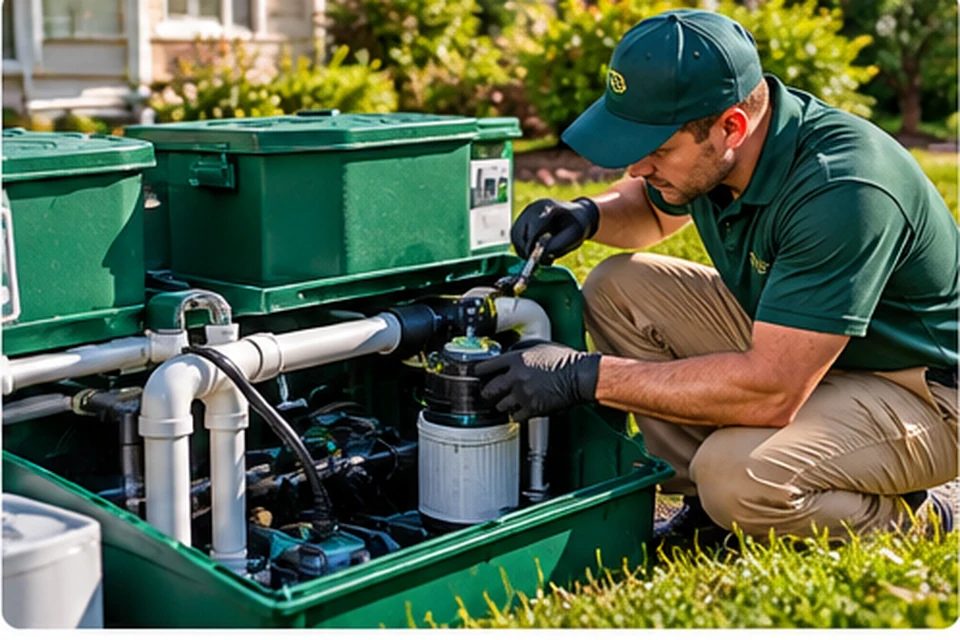
During an aerobic septic service visit, the technician checks that each component is working and records the results. In Texas, TCEQ requires the licensed maintenance provider to inspect the system’s components and note whether every component is working on each visit, test the system as required by 30 TAC §285.91(4), and tag the system at the start of each contract. If a component is not working properly, the owner must have it repaired.
A typical visit covers:
- Aerator: running and moving air
- Chlorinator: tablets present and feeding; residual chlorine checked
- Pump and floats: pump runs on demand and the alarm works
- Spray heads: spraying properly, not clogged or broken
- Sludge level: measured to decide whether pumping is needed
- Alarm and control panel: lights and audible alarm working
Texas AgriLife lists the test equipment involved, including a chlorine DPD test kit, a sludge profile probe, a dissolved oxygen kit and a pressure gauge.
What does an aerobic septic maintenance contract include?
An aerobic septic maintenance contract sets the visit schedule, the tasks the provider performs and what the homeowner handles. Texas AgriLife Extension says a basic monitoring contract meets the state’s minimum requirement but leaves more maintenance to the homeowner, while fuller contracts provide more service with less homeowner involvement. AgriLife advises confirming in the contract who handles each task and what the base price covers.
Texas maintenance contract rules
Texas has detailed written rules for aerobic and other systems that require maintenance. According to TCEQ:
- The maintenance provider must be a licensed maintenance provider.
- The contract must specify a response time for owner complaints and the name of the individual who will do the work.
- The provider must report at least once every four months to the permitting authority and the owner, or every six months for systems with an electronic monitor that alerts the provider and tracks disinfection.
- Reports are due within 14 days after testing and must include responses to owner complaints and monitoring alerts.
Williamson County, Texas adds that owners must keep a valid maintenance contract in place at all times, renew the contract and operating license at least every two years, and file a license transfer form when the property sells.
Rules differ by state and county. Check with your local permitting authority, and see our septic licensing pages and the Texas septic licensing page.
Can homeowners maintain their own aerobic septic system?
Homeowners can maintain their own aerobic septic system in some places, with limits. In Texas, TCEQ allows homeowners to perform maintenance on eligible systems starting two years after the aerobic unit is installed, and notes that some local permitting authorities have adopted stricter requirements. Williamson County says owners who live in the home may maintain their own system with proper training.
Texas AgriLife Extension cautions that attempting maintenance beyond your training can void warranties and cause injury or death, and recommends protective gear, strict hygiene, proper sampling and keeping performance records.
What chlorine tablets should you use in an aerobic septic system?
Use calcium hypochlorite tablets certified by EPA for wastewater disinfection in an aerobic septic system’s chlorinator. TCEQ warns against pool chlorine tablets made from trichloroisocyanuric acid, which it says are not approved by EPA for wastewater effluent disinfection, and states that calcium hypochlorite tablets kill 99% of bacteria in effluent within 10 minutes.
Texas AgriLife adds two handling rules: chlorine tablets release chlorine gas, so do not store them in the house, the garage or near metal tools, and keep disinfectant in the unit at all times.
How do you care for aerobic spray heads and the spray field?
Care for aerobic spray heads by keeping them clear, upright and unobstructed, and by treating the spray area as off-limits for contact. Texas AgriLife Extension says treated effluent is not drinking water and residents and pets should avoid contact with it, and that Texas regulations prohibit applying effluent to vegetable gardens.
AgriLife also points to warning signs in the spray field: spraying during a rain shower can mean rainwater is getting into the system, and ground depressions or unusually dark, fast-growing grass deserve a closer look. Keep riser lids sealed.
What should you do when the aerobic septic alarm goes off?
When the aerobic septic alarm goes off, reduce water use and call your maintenance provider, because the alarm means a component needs attention. Do not open tanks or reach into chambers. Because Texas contracts must specify a response time for owner complaints, check your contract for how quickly the provider should respond. See our septic alarm guide for what the lights and sounds usually mean.
After a flood, the EPA notes that aerobic plants can clog with mud and sediment and need cleaning, and advises examining all electrical connections for damage before restoring power.
What should you avoid with an aerobic septic system?
Avoid anything that kills the bacteria or overloads the system. Texas AgriLife Extension lists:
- Overusing bleach, liquid soap or antibacterial soap
- Toxic drain cleaners and powdered detergent
- Flushing wet wipes, diapers, cat litter, coffee grounds, cigarette filters or feminine hygiene products
- Flushing antibiotics or other drugs
- Running a whirlpool tub or several showers at once without added capacity
- Sending air conditioner condensate or water-softener backwash into the system
- Heavy laundry right after returning from vacation (build back up over a couple of days)
How much does aerobic septic maintenance cost?
Aerobic septic maintenance costs vary by contract, and we could not find a published national average for aerobic service contracts. For context, Angi puts routine septic maintenance at $300 to $500 per visit, most pump repairs at $250 to $400, and aerobic system replacement at $10,000 to $20,000 in 2026. Skipping maintenance on a system that costs that much to replace is a poor trade. See aerobic septic system cost for installation pricing.
Find a licensed aerobic maintenance provider
Aerobic septic maintenance is ongoing work, so choose a provider licensed for it in your state. Find a licensed septic company near you that offers aerobic service contracts, and check the provider’s license with the issuing agency before you sign. More on how these systems work is in our aerobic septic systems guide.
Common questions
How often does an aerobic septic system need maintenance?
An aerobic septic system needs professional maintenance more often than a conventional system. The EPA says systems with mechanical parts generally need inspection once a year, and Texas AgriLife Extension says aerobic units are usually inspected once every 4 months. In Texas, TCEQ requires maintenance reports at least once every four months.
Is a maintenance contract required for an aerobic septic system?
A maintenance contract for an aerobic septic system is required in Texas and some other places. TCEQ requires service by a licensed maintenance provider, and Williamson County, Texas says owners must keep a valid contract at all times and renew it at least every two years. Requirements vary by state and county.
What chlorine tablets go in an aerobic septic system?
Aerobic septic systems use calcium hypochlorite chlorine tablets certified by EPA for wastewater disinfection. The Texas Commission on Environmental Quality warns not to use pool chlorine tablets made from trichloroisocyanuric acid, which it says are not approved by EPA for wastewater effluent disinfection.
Can I maintain my own aerobic septic system?
In Texas, a homeowner can maintain an eligible aerobic septic system starting two years after installation, according to TCEQ, though some local permitting authorities have stricter rules. Texas AgriLife Extension warns that maintenance beyond your training can void warranties and cause injury.
How often should an aerobic septic tank be pumped?
An aerobic septic tank should be pumped based on sludge depth and the manufacturer's recommendations, not a fixed calendar, according to TCEQ. Texas AgriLife Extension notes that overloaded systems need sludge removed more often than normal.
Sources
- OSSF Maintenance, Texas Commission on Environmental Quality. Accessed October 20, 2026. Licensed maintenance provider; reports at least every four months (six with electronic monitoring); homeowner maintenance two years after install; calcium hypochlorite tablets, not pool tablets
- Living with an Aerobic Treatment Unit and Spray Field (B-6234), Texas AgriLife Extension Service, Texas A&M University System. Accessed October 20, 2026. Components; inspect usually every 4 months; chlorine tablet storage; spray field cautions; contract types; homeowner do's and don'ts
- How a Septic System Works, Williamson County, Texas. Accessed October 20, 2026. Maintenance contract required; renew at least every two years; license transfer at sale
- How to Care for Your Septic System, U.S. Environmental Protection Agency. Accessed October 20, 2026. Systems with mechanical parts generally inspected once a year; service contract important for alternative systems
- Septic Systems - What to Do after the Flood, U.S. Environmental Protection Agency. Accessed October 20, 2026. Aerobic plants can clog with mud and sediment; check electrical connections before restoring power
- How Much Does It Cost to Repair a Septic Tank? [2026 Data], Angi. Accessed October 20, 2026. Aerobic (ATU) replacement $10,000-$20,000; pump repair $250-$400; routine maintenance $300-$500 per visit