The short answer
A conventional septic system settles wastewater in a tank and lets soil in a gravel trench finish treatment, while an aerobic treatment unit (ATU) pumps air into the tank to treat wastewater more thoroughly before it reaches the ground. HomeAdvisor puts a traditional anaerobic system at $3,000 to $8,000 and an aerobic system at $10,000 to $20,000 (2026). The EPA says ATUs suit small lots, poor soil, high water tables and sites near sensitive water, but require electricity and regular lifetime maintenance.
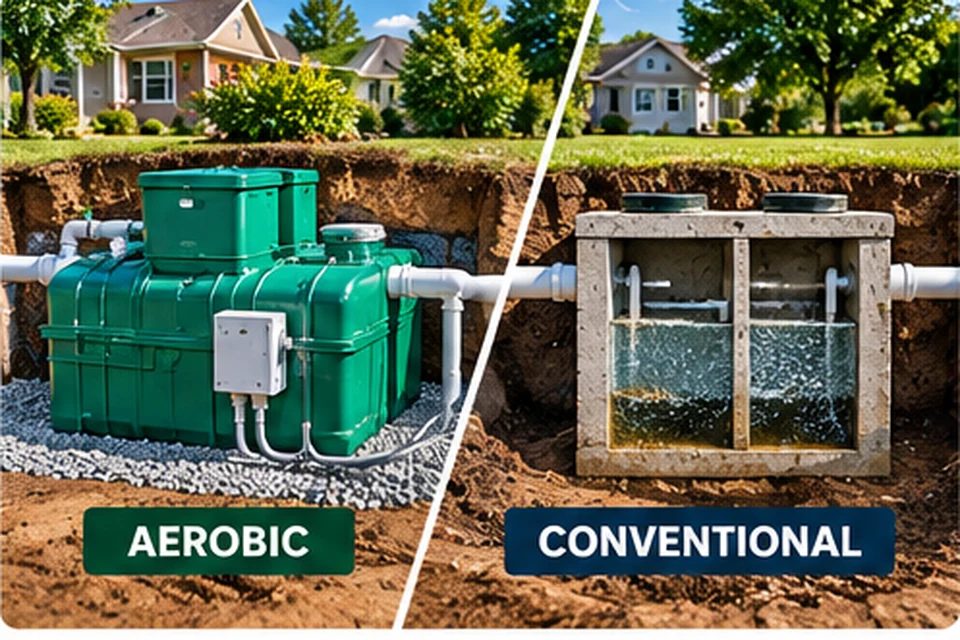
The difference between aerobic and conventional septic systems is oxygen. A conventional septic system lets wastewater settle in a tank without added air and relies on soil beneath a gravel trench to finish treatment, while an aerobic treatment unit (ATU) pumps air into the tank so oxygen-loving bacteria break waste down faster and more completely. Aerobic systems produce cleaner effluent and fit sites where a conventional system will not work, but they cost more to install, need electricity and require regular service.
How does a conventional septic system work?
A conventional septic system sends wastewater from the house into a buried septic tank, where solids settle and scum floats, and then pipes the liquid effluent to a shallow underground trench of stone or gravel. The U.S. EPA explains that microbes in the soil below the trench further treat the effluent. The EPA notes that a conventional system is typically installed at a single-family home or small business, and that gravel and stone systems are relatively large and may not suit every residential site. More detail is in the conventional septic system guide.
How does an aerobic septic system work?
An aerobic septic system injects oxygen into a treatment tank to increase bacterial activity. The EPA says this provides additional nutrient treatment, and that some ATUs include a final tank with disinfection to reduce pathogens further. The EPA compares ATUs to a municipal sewage plant on a smaller scale.
Oklahoma State University Extension describes four stages in a typical ATU:
- Trash tank. Solids settle and float out, as in a conventional septic tank.
- Aeration tank. A compressor or aerator supplies air; OSU says this stage can decompose up to 98 percent of solids and dissolved organics.
- Clarifier. Remaining solids settle and return to the aeration chamber.
- Disinfection and dispersal. Treated effluent is disinfected, usually by chlorination, when it will be sprayed on the surface, then dispersed by spray irrigation or subsurface drip.
Texas A&M AgriLife Extension stresses that aerobic systems must have a continuous supply of oxygen to keep the microbes healthy. See the aerobic septic systems guide for components and service details.
Aerobic vs. conventional septic: comparison table
| Conventional septic | Aerobic septic (ATU) | |
|---|---|---|
| Treatment | Anaerobic settling in the tank; soil microbes treat effluent below a gravel trench (EPA) | Air injected into the tank for additional nutrient treatment; optional disinfection (EPA) |
| Installation cost (2026) | $3,000 to $8,000 for a traditional anaerobic system (HomeAdvisor) | $10,000 to $20,000 (Angi; HomeAdvisor) |
| Electricity | No aerator; Angi describes anaerobic systems as simpler | Constant power needed for the aerator and other components (Angi) |
| Routine maintenance | Inspect at least every 3 years; pump typically every 3 to 5 years (EPA) | Inspect about once a year with a service contract (EPA); regular lifetime maintenance expected (EPA) |
| Drain field size | Gravel systems are relatively large (EPA) | Smaller drain field requirements (Angi); shorter soil separation in Oklahoma rules (OSU) |
| Typical sites | Single-family homes and small businesses with suitable soil (EPA) | Small lots, poor soil, high water table, near nutrient-sensitive water (EPA) |
| Moving parts | Few | More moving parts and higher risk of mechanical failure (Angi) |
| Effluent quality | Treated mainly in the soil | Cleaner effluent, suitable for surface irrigation (Angi) |
How much does an aerobic septic system cost compared with a conventional system?
An aerobic septic system costs roughly two to three times as much to install as a conventional system. HomeAdvisor puts a traditional anaerobic system at $3,000 to $8,000 and an aerobic system at $10,000 to $20,000, and Angi gives the same $10,000 to $20,000 range for aerobic systems, attributing the difference to the aeration equipment and multi-stage treatment. For context, HomeAdvisor says most homeowners spend about $8,016 on a septic system across all types.
The ongoing cost gap matters as much as the installation price:
- Electricity. Angi notes an aerobic system needs a constant power supply. The HyAir owner’s manual says its pump and control panel together use less power than a medium-sized microwave; other brands vary.
- Service contracts. The EPA recommends a service contract for systems with mechanical components, and Texas requires a contract with a licensed maintenance provider for aerobic systems, at least initially.
- Parts. Angi lists regular inspections, pump servicing and component replacements as ongoing aerobic costs. The EPA notes that many pumps and controls need replacement every 10 to 20 years.
See aerobic septic system cost for detailed pricing.
How does maintenance differ between aerobic and conventional systems?
An aerobic septic system needs far more frequent attention than a conventional system. The EPA recommends inspecting an average household system at least every three years and pumping typically every 3 to 5 years, but says alternative systems with electrical float switches, pumps or mechanical components should generally be inspected about once a year, ideally under a service contract. The EPA’s description of ATUs says regular lifetime maintenance should be expected.
State rules can be stricter. In Texas, the Texas Commission on Environmental Quality (TCEQ) requires aerobic system owners to have a contract with a licensed maintenance provider and requires maintenance reports at least every four months (every six months with electronic monitoring). TCEQ allows homeowners to maintain certain aerobic systems themselves two years after installation, though some local authorities require training or prohibit it. Texas A&M AgriLife Extension advises inspecting an ATU usually once every 4 months. In Oklahoma, OSU Extension says installers must maintain an ATU at no cost to the owner for two years after installation.
Aerobic systems also use alarms to flag aerator or pump problems; see septic alarm for what to do when one sounds.
When is an aerobic septic system used instead of a conventional one?
An aerobic septic system is used where the soil or lot cannot treat effluent from a conventional system. The EPA says ATUs are used for homes with smaller lots, inadequate soil conditions, a high water table, or proximity to surface water that is sensitive to nutrient contamination. Oklahoma State University Extension adds that ATUs are used where soil is too clayey, too sandy or too shallow over an impervious or saturated layer, and that conventional systems are preferred in areas with deep, medium-textured soil.
Is an aerobic system required in my state?
Whether an aerobic system is required depends on your site evaluation and your state’s rules. The EPA notes that some states permit alternative systems where conventional soil-based systems are not allowed. In Oklahoma, for example, OSU Extension reports that NSF Standard 40 aerobic systems need a lot of at least 3/4 acre with a private well or 1/2 acre with a public water system. Your county health department or permitting authority decides which system types your lot qualifies for; see septic permits and septic licensing by state.
Are aerobic systems good for vacation homes?
Aerobic septic systems are a poor fit for homes used only occasionally. Oklahoma State University Extension says ATUs do poorly in seasonal or vacation homes because the microorganisms need a steady food supply, and advises reducing water use for at least two days after weeks of disuse so the microbial population can recover.
Which lasts longer, aerobic or conventional?
Lifespan depends more on maintenance and site conditions than on system type, but aerobic systems have more parts that wear out. The EPA says a concrete septic tank may last 50 years or more, while many pumps and controls need replacement every 10 to 20 years, and advises checking with the manufacturer for advanced treatment unit lifespan and warranty details. Ask the installer for the warranty terms on the aerator, pumps and controls before buying.
Aerobic vs. conventional: which should you choose?
Choose a conventional septic system if your site evaluation shows suitable soil and enough space, because it costs less to install and run. Choose an aerobic system when the lot is small, the soil is poor, the water table is high or local rules require advanced treatment. In most cases the decision is made by the soil test and the permitting authority rather than the homeowner. Compare all options in types of septic systems.
Finding a licensed septic installer or maintenance provider
Both system types should be designed, installed and serviced by licensed professionals, and aerobic systems in some states require a licensed maintenance provider. The Septic Guide lists 28,546 septic companies and licensed septic professionals in 45 states, with 27,065 matched to license or certification lists published by 26 state agencies. Find a licensed septic company near you and check the contractor’s license before signing a contract.
Common questions
What is the difference between an aerobic and a conventional septic system?
A conventional septic system relies on anaerobic bacteria in the tank and microbes in the soil beneath a gravel trench to treat wastewater, with no added air. An aerobic septic system injects oxygen into a treatment tank, which the EPA says increases bacterial activity and provides additional nutrient treatment, often followed by disinfection. Aerobic systems produce cleaner effluent but need electricity and more maintenance.
Is an aerobic septic system better than a conventional system?
An aerobic septic system is better only where site conditions call for it. The EPA says aerobic treatment units suit homes with smaller lots, inadequate soil, a high water table or nearby water sensitive to nutrients, and Oklahoma State University Extension says conventional systems are preferred where soil is deep and medium-textured. Where a conventional system works, it costs less to install and maintain.
How much more does an aerobic septic system cost than a conventional one?
An aerobic septic system costs $10,000 to $20,000 to install, according to both Angi and HomeAdvisor, while HomeAdvisor puts a traditional anaerobic system at $3,000 to $8,000. An aerobic septic system also carries ongoing costs a conventional system does not, including electricity for the aerator, a maintenance contract in some states and replacement parts.
Does an aerobic septic system need electricity?
Yes. An aerobic septic system needs a constant power supply to run the aerator and other components, according to Angi. The HyAir owner's manual says owners must provide a continuous electrical supply and that the equipment will lose power in an outage like any household appliance, with battery backup available as an option.
How often does an aerobic septic system need maintenance?
An aerobic septic system needs more frequent maintenance than a conventional system. The EPA says systems with pumps, float switches or mechanical components should generally be inspected about once a year with a service contract, and in Texas the TCEQ requires maintenance reports at least every four months. A conventional system typically needs inspection at least every 3 years and pumping every 3 to 5 years.
Sources
- Types of Septic Systems (January 19, 2025 snapshot), U.S. Environmental Protection Agency. Accessed October 20, 2026. How conventional systems and ATUs work; where ATUs are used; lifetime maintenance
- What Is an Aerobic Septic System?, Angi. Accessed October 20, 2026. Aerobic install $10,000-$20,000; constant power for the aerator; pros and cons
- Septic System Installation Cost, HomeAdvisor. Accessed October 20, 2026. Anaerobic (traditional) $3,000-$8,000; aerobic $10,000-$20,000; average system ~$8,016
- Aerobic Treatment System (PSS-2275), Oklahoma State University Extension. Accessed October 20, 2026. ATU stages; up to 98% decomposition in aeration tank; site conditions; Oklahoma lot sizes; seasonal-use caution
- OSSF Maintenance, Texas Commission on Environmental Quality. Accessed October 20, 2026. Licensed maintenance provider contracts; reports every 4 months; homeowner maintenance after 2 years
- Living with an Aerobic Treatment Unit and Spray Field (B-6234), Texas A&M AgriLife Extension. Accessed October 20, 2026. ATU treatment stages; continuous oxygen supply; inspect about every 4 months
- How to Care for Your Septic System, U.S. Environmental Protection Agency. Accessed October 20, 2026. Household systems inspected at least every 3 years, pumped every 3-5; mechanical systems about yearly with service contract
- Frequent Questions on Septic Systems (January 19, 2025 snapshot), U.S. Environmental Protection Agency. Accessed October 20, 2026. Alternative systems allowed where conventional are not; concrete tank 50+ years; pumps and controls 10-20 years
- HyAir Owners Manual (hosted by Rhode Island DEM), Advanced Wastewater Solutions / Rhode Island Department of Environmental Management. Accessed October 20, 2026. Owner must provide continuous power; pump and panel use less power than a medium microwave; battery backup optional