The short answer
A septic perc test (percolation test) measures how quickly water drains through saturated soil, in minutes per inch, to decide whether a lot can support a septic drain field and what type and size of system it needs. University of Nebraska-Lincoln Extension says soil suited to a soil absorption system drains slower than 5 and faster than 60 minutes per inch. Angi puts the national average perc test cost at about $1,300 in 2026, with most homeowners paying $750 to $1,900.
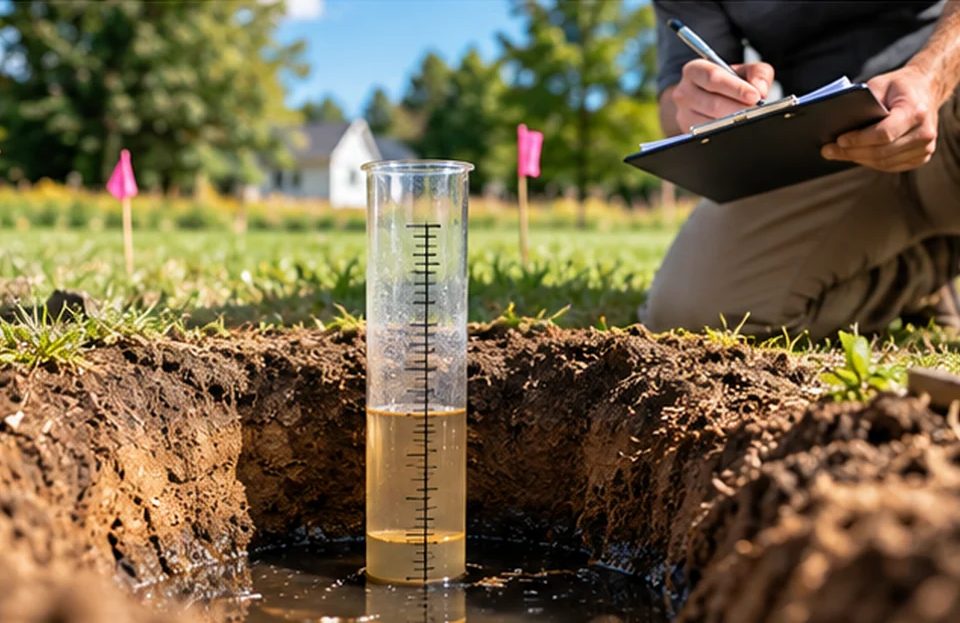
A septic perc test, short for percolation test, measures how quickly water soaks into saturated soil so that a health department or designer can decide whether a lot can support a septic drain field and what kind of system it needs. Results are reported in minutes per inch: how many minutes it takes the water level in a test hole to drop one inch.
A perc test usually comes before a septic permit for new construction, and sometimes before a replacement system. Buyers of rural land can make a purchase contingent on a passing result, because a lot that cannot pass may need a far more expensive system or may not be buildable with septic at all.
What does a septic perc test measure?
A septic perc test measures the rate of water movement through saturated soil, which mimics the conditions a drain field faces once it is in use. The Nebraska Water Center at the University of Nebraska-Lincoln describes the test as measuring “how quickly an inch of water will drop in a hole after the soil has been saturated with water.”
The rate matters in both directions:
- Too fast means wastewater passes through before the soil can treat it.
- Too slow means the soil cannot accept wastewater as fast as the house produces it, so effluent backs up or surfaces.
University of Nebraska-Lincoln Extension says soil suited to a soil absorption system should drain slower than 5 minutes per inch, to allow treatment, and faster than 60 minutes per inch, to accept ongoing wastewater.
What is the difference between a perc test and a soil evaluation?
A perc test measures drainage rate, while a soil evaluation examines the soil profile itself: its layers, texture and depth to anything that limits treatment. Many programs use both.
Pennsylvania DEP describes two steps in site testing. First, a deep probe: a backhoe pit dug “as deep as eight feet” so the Sewage Enforcement Officer can examine the soil profile. If the soil is unsuitable, no permit is issued. Second, the percolation test in the area of the proposed absorption field. Other states rely more on soil evaluation and less on the perc test, so ask your local health department which it requires.
How does a septic perc test work?
A septic perc test works by digging holes where the drain field will go, saturating the soil with water and timing how fast the water level drops. Exact methods are set by state rules. Here is how two official sources describe the process.
The Nebraska method (UNL Extension NebGuide G1472)
University of Nebraska-Lincoln Extension describes the procedure under Nebraska’s Title 124 rules:
- Dig the holes. At least 3 (preferably 4) holes evenly spaced across the proposed drain field, 4 to 12 inches in diameter and as deep as the proposed trench, with 24 to 30 inches a good average. Do not test disturbed or frozen soil.
- Prepare each hole. Roughen the sides and bottom, remove loose soil and add about 2 inches of clean gravel.
- Presoak. Keep at least 12 inches of water in the hole for at least 4 hours, preferably overnight. Clay soils need at least 12 hours.
- Measure. The next day, refill to 6 inches above the gravel and record the drop at 30-minute intervals (10-minute intervals in sandy soils).
- Calculate the rate. Divide minutes elapsed by inches dropped. A 2-inch drop in 30 minutes equals 15 minutes per inch.
- Average the holes. If holes differ by more than 20 minutes per inch, design for the slowest rate or pick a more uniform location.
The Pennsylvania method (PA DEP)
Pennsylvania DEP requires a minimum of six holes in the area of the proposed absorption field. The soil is presoaked, then given a final one-hour soak on test day. Water-level drops are recorded at 10- or 30-minute intervals, and the test lasts from 40 minutes to four hours depending on the soil, with sandy soils finishing faster than clay soils.
How long does a perc test take?
A perc test usually takes part of a day, plus any presoak time. Angi puts the total at one to eight hours depending on excavation, hole size and depth, and the number of holes, and notes that some companies take a few days to issue the official report.
Who performs a septic perc test?
A septic perc test is performed by the person your state or county authorizes, and that differs widely.
- Pennsylvania: The local agency’s Sewage Enforcement Officer conducts the soil profile examination and percolation tests, according to PA DEP.
- Nebraska: Only a certified inspector, installer or soil evaluator, a Nebraska registered environmental health specialist or a Nebraska licensed professional engineer may conduct the test, according to UNL Extension.
- Elsewhere: Angi says soil testers and licensed excavators usually do the work, and that many municipalities require a building or health department representative on site to decide whether the test passes.
Before digging, call 811 to have utilities marked; UNL Extension advises calling at least two business days ahead in Nebraska. Rules on who can test vary, so check our septic licensing pages or the local health department.
How much does a septic perc test cost in 2026?
A septic perc test costs about $1,300 on average, with most homeowners paying $750 to $1,900, according to Angi’s 2026 data. HomeAdvisor reports the same $750 to $1,900 range and $1,300 average. Angi’s overall range runs from about $300 for a single hand-dug hole to $3,000 for machine-dug holes on a larger property.
Perc test cost by property size
| Property size | Holes needed | Cost (Angi, 2026) |
|---|---|---|
| 1/4 acre | 1 to 4 | $150 to $600 |
| 1/2 acre | 1 to 8 | $150 to $1,200 |
| 3/4 acre | 2 to 12 | $300 to $1,800 |
| 1 acre | 3 to 20 | $450 to $3,000 |
Perc test cost by hole type
| Hole type and depth | Cost per hole (Angi, 2026) |
|---|---|
| Manual, 2 ft | $150 to $300 |
| Manual, 3 ft | $200 to $300 |
| Excavator, 4 ft | $550 to $800 |
| Excavator, 5 ft | $625 to $900 |
| Excavator, 6 ft | $700 to $1,000 |
HomeAdvisor puts soil testing professionals at $100 to $250 per hour and excavation contractors at $100 to $300 per hour including the operator. When the perc test is bundled into a septic installation, Angi’s installation guide puts it at $700 to $2,000. See septic system installation cost for the full budget.
What do perc test results mean for your septic system?
Perc test results decide whether a conventional drain field is allowed and, if not, which alternative the site needs. The Nebraska Water Center says the test helps choose both the type and the size of the treatment system.
| Perc result | What it generally means |
|---|---|
| Within the allowed range | A conventional trench or bed drain field may be possible |
| Faster than the allowed range | Soil may not treat wastewater before it reaches groundwater; a liner, sand filter or other alternative may be needed |
| Slower than the allowed range | Soil cannot accept enough water; an engineered or alternative system may be needed |
UNL Extension gives Nebraska examples: soil faster than 5 minutes per inch may be usable by digging deeper and adding a soil liner, soil slower than 60 minutes per inch may allow a lagoon on a lot of at least three acres, and alternatives such as mound systems need a professional engineer’s design and state approval.
Pennsylvania DEP lists five system variations that site testing can lead to: a standard trench, a seepage bed, a subsurface sand filter, an elevated sand mound and an individual residential spray irrigation system. A standard system is used when the soil suits one, and alternates are considered when it does not. Learn more in our guides to types of septic systems and the mound septic system.
The system type a perc test points to drives cost. Angi’s 2026 installation figures put a basic anaerobic system at $3,000 to $8,000 and mound or aerobic systems at $10,000 to $20,000.
What happens if you fail a perc test?
If you fail a perc test, a conventional drain field may not be permitted, but the lot may still qualify for an alternative system. Angi notes that many municipalities allow a second opinion, and that if a retest fails, the land may need changes such as regrading before the project can go forward. In Pennsylvania, a denied permit can be appealed at a hearing, according to PA DEP.
How long are perc test results valid?
Perc test results stay valid for two to five years depending on local rules, according to Angi. If you test a lot before buying it, check the validity period so the result does not expire before you apply for a septic permit.
Find a licensed septic professional for site testing
A perc test is the first step toward a permitted septic system, so work with a septic designer or installer who is licensed in your state and knows the local health department’s process. Find a licensed septic company near your property, and check the contractor’s license with the issuing agency before you schedule the test. Our septic system installation guide covers what comes after a passing result.
Common questions
What is a perc test for a septic system?
A perc test for a septic system is a percolation test that measures how quickly water drains through saturated soil, reported in minutes per inch. Health departments and designers use perc test results to decide whether a lot can support a septic drain field and what type and size of system it needs.
How much does a septic perc test cost?
A septic perc test costs about $1,300 on average, according to Angi's 2026 data, with most homeowners paying $750 to $1,900. Angi reports a range from about $300 for one hand-dug hole to $3,000 for machine-dug holes on a larger property.
What is a good perc test result?
A good perc test result falls inside the range a conventional drain field can use. University of Nebraska-Lincoln Extension says soil suited to a soil absorption system should drain slower than 5 minutes per inch and faster than 60 minutes per inch. The acceptable range in your area is set by state or local rules.
What happens if a lot fails a perc test?
If a lot fails a perc test, a conventional drain field may not be allowed, but an alternative system may still be possible. Pennsylvania DEP lists options such as subsurface sand filters, elevated sand mounds and spray irrigation, and Angi notes many municipalities allow a second test.
Who performs a perc test?
A perc test is performed by whoever the state or county authorizes. In Pennsylvania, the local Sewage Enforcement Officer conducts soil and perc testing; in Nebraska, it must be a certified inspector, installer or soil evaluator, a registered environmental health specialist or a licensed engineer.
Sources
- Residential Onsite Wastewater Treatment: Conducting a Soil Percolation Test (NebGuide G1472), University of Nebraska-Lincoln Extension. Accessed October 20, 2026. Step-by-step procedure; 5-60 minutes per inch suitability range; who may perform the test in Nebraska
- Soil & Site Evaluation, University of Nebraska-Lincoln, Nebraska Water Center. Accessed October 20, 2026. Perc test measures how quickly an inch of water drops after saturation; results in minutes per inch
- Understanding Septic Systems (Act 537 Fact Sheet #1, 3800-FS-DEP1414), Pennsylvania Department of Environmental Protection. Accessed October 20, 2026. Deep probe up to eight feet; minimum six perc holes; SEO conducts testing; five system variations
- How Much Does a Perc Test Cost? [2026 Data], Angi. Accessed October 20, 2026. Average about $1,300; $750-$1,900 typical; $300-$3,000 overall; cost by property size and hole type; results valid 2-5 years
- How Much Does a Perc Test Cost?, HomeAdvisor. Accessed October 20, 2026. $750-$1,900, average $1,300; soil testing pros $100-$250 per hour
- How Much Does a Septic System Cost? [2026 Data], Angi. Accessed October 20, 2026. Perc test $700-$2,000 as part of installation; system costs by type