The short answer
Septic tank size is set by the number of bedrooms, not square footage. Angi's 2026 chart and New York's state table (10 NYCRR Appendix 75-A, Table 3) both list a 1,000-gallon minimum for one to three bedrooms, 1,250 gallons for four, 1,500 for five and 1,750 for six. Some states set lower floors: Pennsylvania's code requires at least 900 gallons for any installation, so your state or county rule is the one that counts.
Most homes with one to three bedrooms need a septic tank of at least 1,000 gallons, a four-bedroom home needs at least 1,250 gallons, and each additional bedroom adds about 250 gallons. Those are the minimums in Angi’s 2026 sizing chart and in New York’s state septic table (10 NYCRR Appendix 75-A, Table 3). Septic tank size is set by bedroom count because bedrooms predict how many people, and how much wastewater, a house can generate.
States set their own minimums, and some differ. Pennsylvania’s code sets a 900-gallon floor, for example. Use the chart below as a guide and confirm the number with your local permitting office before buying a tank.
What size septic tank do I need by number of bedrooms?
Septic tank minimums by bedroom count are nearly identical in Angi’s 2026 chart and New York’s Appendix 75-A table, as reproduced by Cornell Cooperative Extension.
| Bedrooms | Minimum tank (Angi 2026) | Minimum tank (New York, 10 NYCRR 75-A Table 3) | Min. liquid surface area (NY) |
|---|---|---|---|
| 0 (studio, loft) | 750 gallons | Not listed | Not listed |
| 1–3 | 1,000 gallons | 1,000 gallons | 27 sq ft |
| 4 | 1,250 gallons | 1,250 gallons | 34 sq ft |
| 5 | 1,500 gallons | 1,500 gallons | 40 sq ft |
| 6 | 1,750 gallons | 1,750 gallons | 47 sq ft |
| 7+ | Not listed | Add 250 gallons and 7 sq ft per bedroom over six |
Angi notes that 750-gallon tanks are now considered inadequate for basic residential use, and that the average residential tank holds about 1,250 gallons.
Why is septic tank size based on bedrooms?
Septic tank size is based on bedrooms because bedrooms cap how many people a home can hold, and people set the water load. Angi estimates occupants use 50 to 100 gallons per day in a typical U.S. home. Bob Vila describes a common rule of thumb: bedrooms × 150 gallons × 2, which assumes two people per bedroom.
Rules translate bedrooms into a design flow and then into a tank volume. Pennsylvania’s code (25 Pa. Code § 73.31) is a good example of the math:
- A single-family home uses a design flow of 400 gallons per day.
- The design flow rises by 100 gallons per day for each bedroom over three.
- For design flows up to 500 gallons per day, the tank must hold 3.5 times the flow above 400, plus 900 gallons.
- No tank may be smaller than 900 gallons.
Worked through, that gives 900 gallons for a three-bedroom Pennsylvania home and 1,250 gallons for four bedrooms (500 gpd: 3.5 × 100 + 900). The Pennsylvania DEP confirms that homes with three bedrooms or fewer need a tank of at least 900 gallons.
Do states set different septic tank size minimums?
Every state, and often the county, sets its own septic tank minimums, and the numbers are not uniform. Two examples from state sources:
- New York: 10 NYCRR Appendix 75-A.6 sizes tanks by bedrooms using Table 3 above. It counts an expansion attic as an additional bedroom, counts a garbage grinder as an additional bedroom, adds 250 gallons per bedroom beyond six, and requires a minimum liquid depth of 30 inches.
- Pennsylvania: 25 Pa. Code § 73.31 sets a 900-gallon minimum for any installation, with the bedroom formula described above.
New Jersey adds a garbage disposal rule: the NJDEP primer says N.J.A.C. 7:9A requires a tank 50% larger and a drain field 25% larger when a disposal is installed.
For your state’s rules and who enforces them, see septic licensing and septic permits. Tank size is approved as part of the system permit.
What else affects septic tank size?
Several factors beyond bedroom count can push the required septic tank size up:
- Garbage disposals. New York adds 250 gallons for a garbage grinder, and New Jersey requires a 50% larger tank, per the sources above.
- Expansion space. New York counts an expansion attic as a bedroom. Cornell Cooperative Extension advises designing new systems for expected future needs, such as a planned addition, and notes a larger tank allows for expansion.
- More than two people per bedroom. Bob Vila notes that added bedrooms or more than two people per bedroom can overload a tank sized by the standard formula.
- Compartments. New York recommends dual compartments for all tanks and requires them when the tank’s interior length is 10 feet or more.
What size are septic tanks by material?
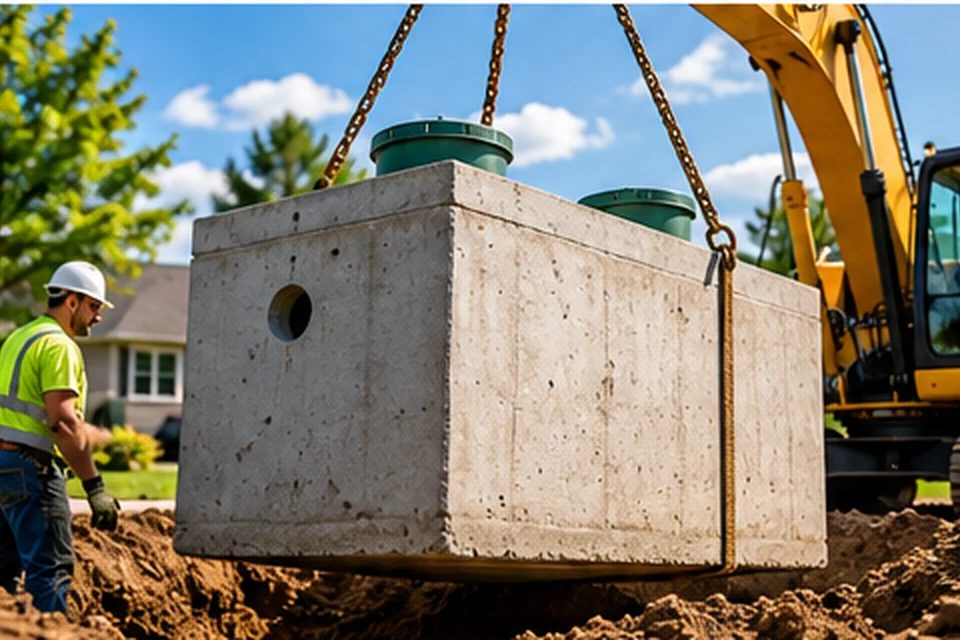
Septic tank material limits how large a single tank can be. Angi reports concrete tanks are available up to 5,000 gallons, steel up to about 2,000 gallons, and plastic and fiberglass up to about 1,500 gallons. Larger capacities can be met with two tanks in series where the rules allow it. Angi describes a typical residential tank as about 4.5 feet wide, 8 feet long and 6 feet tall.
How big is a septic tank physically, and how deep is it buried?
A typical residential septic tank is about 4.5 feet wide, 8 feet long and 6 feet tall, according to Angi, which says tanks are typically buried between 4 inches and 4 feet deep. Depth inside the tank matters too: New York’s Appendix 75-A.6 requires a minimum liquid depth of 30 inches and gives no design-volume credit for liquid depth beyond 60 inches, so a very deep, narrow tank does not count as larger on paper. The same New York rule requires the inlet and outlet to be at least six feet apart, which gives solids room to settle before effluent leaves the tank.
How much does each septic tank size cost?
Septic tank prices rise with capacity. Publishers report these tank-only ranges:
| Tank size | HomeAdvisor (June 2026), installed tank price | Fixr (January 2025), materials only |
|---|---|---|
| 750 gallons | $700–$1,200 | $720–$1,200 |
| 1,000 gallons | $900–$1,500 | $800–$2,000 |
| 1,200 gallons | $1,200–$1,600 | $1,200–$2,000 |
| 1,500 gallons | $1,500–$2,500 | $1,300–$2,500 |
| 2,000 gallons | Not listed | $2,500–$4,000 |
Angi (2026) puts the tank alone at $900 to $1,500 for a 1,000-gallon tank serving most one- to three-bedroom homes. Note that HomeAdvisor’s chart pairs tank sizes with bedroom counts below the state minimums above (for example, 750 gallons for two bedrooms); follow your state’s minimum, not a price chart. For the full system price, see septic system installation cost and septic tank replacement cost.
Does a bigger septic tank need less pumping?
A bigger septic tank holds more sludge before it needs pumping, so for the same household it can go longer between pump-outs. The Pennsylvania DEP gives an example for a 900-gallon tank on a three-bedroom home: six residents should pump about every 1.3 years, while two residents can wait about 5.2 years. The NJDEP primer says a 1,000- to 1,250-gallon tank serving a family of four is typically pumped about every 3 years. See how often to pump a septic tank.
A larger tank does not let you skip maintenance, and it does not replace a properly sized drain field; both are sized together by the system designer. Learn how the tank and drain field work together in how septic systems work.
Find a licensed septic installer
The right septic tank size is the one your permit specifies. A licensed installer or designer will size the tank to your bedrooms, local code and soil test. Find a licensed septic company near you and check the contractor’s license before you hire.
Common questions
What size septic tank do I need for a 3-bedroom house?
A 3-bedroom house typically needs a septic tank of at least 1,000 gallons. Angi's 2026 sizing chart and New York's state table (10 NYCRR Appendix 75-A) both set 1,000 gallons as the minimum for one to three bedrooms. Pennsylvania's floor is lower, at 900 gallons, so check your state and county rule.
What size septic tank do I need for a 4-bedroom house?
A 4-bedroom house typically needs a septic tank of at least 1,250 gallons. Angi's 2026 chart and New York's Appendix 75-A table both list 1,250 gallons for four bedrooms. Pennsylvania's formula (25 Pa. Code § 73.31) also works out to 1,250 gallons for four bedrooms.
Is septic tank size based on bathrooms or square footage?
Septic tank size is based on bedrooms in most rules, not bathrooms or square footage. New York's Appendix 75-A sizes tanks by the number of bedrooms and counts an expansion attic as an additional bedroom, and Pennsylvania's code raises the design flow by 100 gallons per day for each bedroom over three. Bedrooms are used as a stand-in for the number of people who could live in the house.
Does a garbage disposal change the septic tank size?
A garbage disposal increases the required septic tank size in some states. New York's Appendix 75-A counts a garbage grinder as an additional bedroom and adds 250 gallons, and the New Jersey DEP says New Jersey rules require a tank 50% larger and a drain field 25% larger when a disposal is installed. Disposals also mean more frequent pumping.
Is a 750-gallon septic tank big enough?
A 750-gallon septic tank is below the current minimum for most homes. Angi lists 750 gallons only for zero-bedroom units such as small apartments and lofts and says 750-gallon tanks are now considered inadequate for basic residential use. Older homes may still have one; the Pennsylvania DEP notes systems installed before 1971 may have tanks smaller than 900 gallons.
Sources
- How Big Is a Septic Tank?, Angi. Accessed October 20, 2026. Minimum capacity by bedrooms; 50-100 gallons per occupant per day; 750-gallon tanks now considered inadequate (July 2026)
- Appendix 75-A.6: Septic Tanks and Enhanced Treatment Units (10 NYCRR), New York State Department of Health. Accessed October 20, 2026. Sizing by bedrooms; +250 gallons per bedroom over six; garbage grinder counts as a bedroom; 30-inch minimum liquid depth
- Your Septic System: Building or Remodeling a Home with a Septic System, Cornell Cooperative Extension. Accessed October 20, 2026. Reproduces NYS Appendix 75-A Table 3 minimum tank capacities
- 25 Pa. Code § 73.31: Standards for Septic Tanks, Commonwealth of Pennsylvania (via Cornell Legal Information Institute). Accessed October 20, 2026. 400 gpd design flow plus 100 gpd per bedroom over three; 900-gallon minimum
- Understanding Septic Systems (Act 537 Fact Sheet #1), Pennsylvania Department of Environmental Protection. Accessed October 20, 2026. Homes with three bedrooms or fewer need at least 900 gallons; pre-1971 tanks may be smaller
- Septic Systems 101: A Primer to Understanding Your Individual Subsurface Sewage Disposal System, New Jersey Department of Environmental Protection. Accessed October 20, 2026. N.J.A.C. 7:9A requires a 50% larger tank with a garbage disposal; 1,000-1,250 gallon tank for a family of four pumped about every 3 years
- How Long Do Septic Tanks Last?, Bob Vila. Accessed October 20, 2026. Rule of thumb: bedrooms x 150 gallons x 2
- How Much Does a Septic System or Tank Cost?, HomeAdvisor. Accessed October 20, 2026. Tank prices by size (June 2026)
- How Much Does It Cost to Install a Septic Tank System?, Fixr. Accessed October 20, 2026. Tank material cost by capacity, 750-5,000 gallons (Jan 2025)